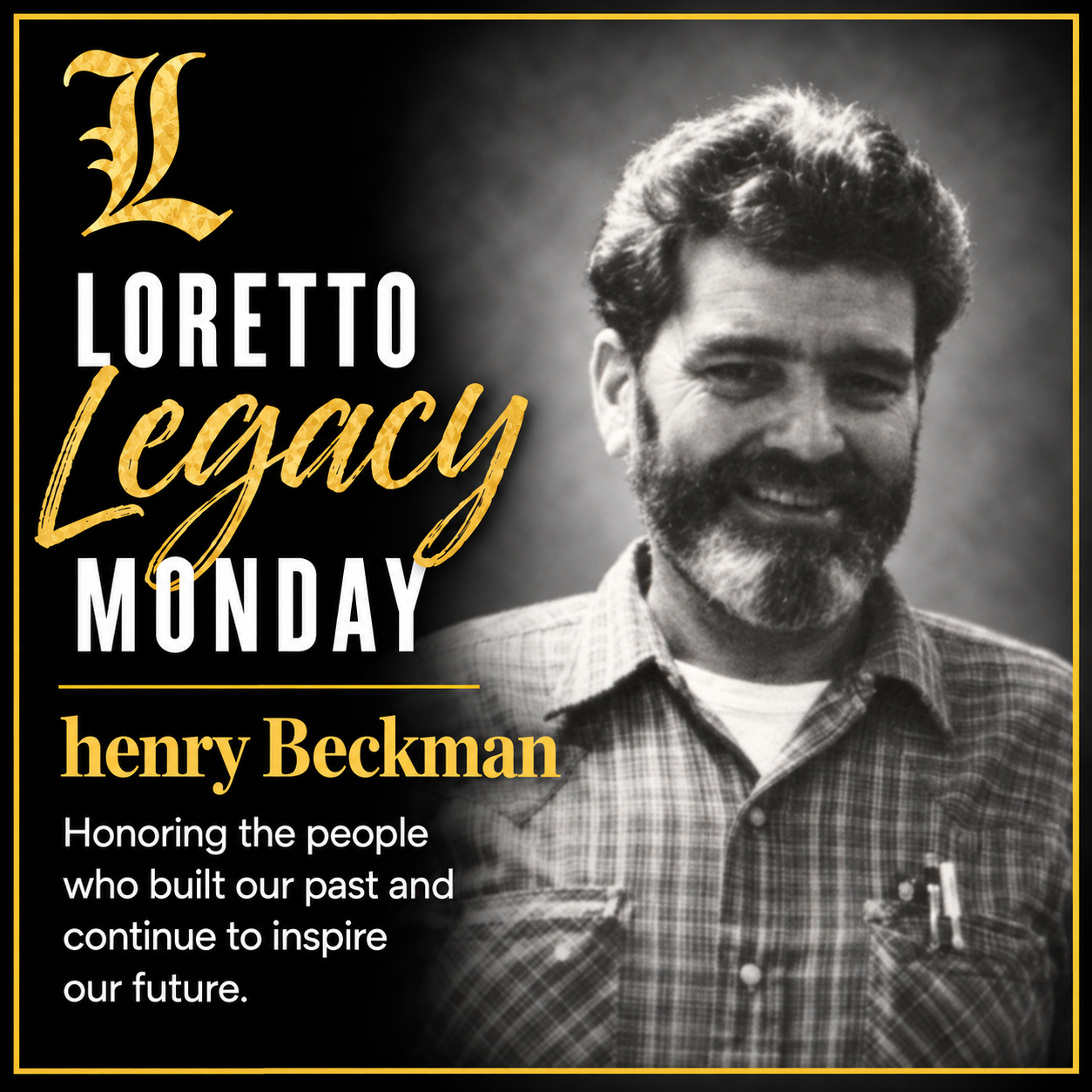
Loretto Legacy Monday: henry Beckman
Some people leave their mark on a community through one career, one accomplishment, or one chapter of life.
henry Beckman left his everywhere.
It can be found in homes across Lawrence County, in the students he taught, in handmade furniture and musical instruments, in newspaper columns and radio stories, in the Loretto Senior Citizens Club, at Sacred Heart Catholic Church, inside a workshop filled with tools and memories, and in generations of family members who learned by simply watching him work.
henry Edwin Beckman passed away at his Loretto home on September 25, 2026, at the age of 95. By then, he had become something difficult to describe with any single title.
Builder. Teacher. Craftsman. Musician. Photographer. Storyteller. Columnist. Navy veteran. Fire chief. Husband. Daddy. Pawpaw.
One friend simply called him a “true Renaissance man.”
Another called him a “treasured legend for our home town.”
Both descriptions fit.
But henry probably would have gotten a bigger kick out of another title he once claimed for himself: “Genuine Antique Organic Fertilizer Peddler.”
That was henry.
There is also one small detail worth explaining from the beginning.
henry didn't capitalize his first name.
He had once heard that in the “Old Country,” people of no prominence didn't capitalize their names, so henry adopted the practice himself.
For a man who would become one of Loretto's most recognizable citizens, it was a fitting reflection of his humility.
And throughout this story, we'll honor that preference the same way he did: henry.
henry was born September 17, 1931, at his family home on Graveyard Hill in Loretto, the second oldest of 14 children born to Conrad and Teresa Beckman.
There were nine boys and five girls in the family. henry once recalled his father joking that he had a baseball team of boys and a basketball team of girls.
The Beckman family was part of the German Catholic community that played an important role in early Loretto, with life centered around Sacred Heart Catholic Church. henry attended Sacred Heart School, walking there with other children from the neighborhood.
Even as a boy, there were signs of what henry would become.
If he happened to get a nickel, he didn't necessarily head to the store for candy.
He bought nails.
When asked what size nails he wanted, the story goes that young henry would tell the merchant to just mix them up. If nails were scarce, he straightened old ones and used them again.
His father was a talented carpenter and painter, and henry developed that same love of making things with his hands.
But his path to becoming one of Loretto's best-known teachers was anything but conventional.
henry was a good student, but during his freshman year of high school, he made the decision to leave school and go to work. With 14 children at home, his parents were struggling to make ends meet, and henry wanted to help.
Years later, that young man who had left school to help support his family would find himself standing at the front of a classroom.
Around 1971, J.C. Barnett approached henry about becoming the General Building instructor as vocational education programs were changing in Lawrence County.
There was one problem.
henry didn't have a high school diploma.
So he earned his GED, took the college courses he needed, and became a teacher.
He would spend the next 23 years teaching General Building, passing along the skills he had spent a lifetime learning.
henry's classroom didn't always have four walls.
His General Building students learned by doing.
Together, they constructed approximately 17 or 18 houses, giving students the opportunity to learn carpentry, construction, responsibility, and problem-solving on real job sites.
But former students learned much more than how to build a house.
henry taught patience.
He taught students to care for their tools.
He taught them that making a mistake wasn't a reason to throw something away.
Fix it.
Learn from it.
Keep going.
“You can't do pretty stuff or good stuff in a hurry,” henry explained during an interview.
It was a philosophy passed down from his own father: whatever you were making, always see if you could make it just a little better.
His students inventoried their tools when they arrived at a job site and again before they left. henry proudly remembered that they didn't lose their tools, and years later, employers told him they could tell his former students had been taught to take care of what they worked with.
One of the greatest measures of his influence came after henry left the classroom.
Former students continued teaching the program.
The teacher had created teachers.
And the lessons kept going.
That may be one of the best definitions of a legacy.
Teaching was only one part of henry's life in construction.
He estimated that over the years, he had worked on, supervised, or otherwise been involved in the construction of around 100 homes. His work also included community and church projects, including the gymnasium at Sacred Heart.
But give henry a piece of wood, and there was no telling what might come out of his shop.
Homes.
Furniture.
Tools.
Toys.
Models.
Puzzles.
Gadgets.
Musical instruments.
His detailed wooden models could contain hundreds of individual pieces and take around 100 hours to complete.
He became particularly well known for building dulcimers. At the time of one interview, henry was working on dulcimer number 216.
They weren't mass-produced instruments.
henry talked with the person receiving each one, discussed the type of wood they wanted, and often carved something personal into the back.
He once told the story of building a dulcimer originally ordered by a woman who died before her name reached the top of his waiting list. Her husband still wanted it made in her memory and told henry to build it however he thought she would have liked.
For reasons he couldn't explain, henry decided to carve a rose into the back.
When the husband saw it, he was stunned.
His late wife had been Irish, he explained, and he had always called her his “wild Irish rose.”
For henry, craftsmanship was never simply about making an object.
It was about the person who would hold it.
For countless people, a visit with henry meant a visit to his workshop.
It became almost as legendary as the man himself.
The shop was filled with tools, woodworking projects, puzzles, antiques, curiosities, and items henry had collected over the years. He joked that people compared it to Cracker Barrel, but there was one big difference:
henry could tell you what everything was.
And visitors were welcome.
His advice was simple: don't come if you're in a hurry.
People often came once and returned later with someone else because they wanted that person to experience it too.
Grandson Josey Sandy remembered spending summer days and after-school hours there, working beside his Pawpaw, watching Braves games, and learning lessons that went far beyond woodworking.
henry expected you to try first.
Then he would help.
And he wouldn't stop until the job was finished.
For Josey, hearing henry say “good job” was about the highest compliment a person could receive.
That same workshop remained part classroom, part museum, and part gathering place throughout henry's life.
Even his faith had a place there. A prayer to St. Anthony, patron saint of lost things, hung in the shop, and henry said he had relied on it many times when something had gone missing.
henry didn't only build with wood.
He built stories.
For years, readers knew his newspaper column, first through The Democrat-Union and later through The Lawrence County Advocate after the newspaper changed ownership in 2025.
henry said he had stories appearing in multiple newspapers and eventually collected his writings into approximately four books.
He was always listening for the next story.
He once recalled advice from songwriter Tom T. Hall: don't simply listen to a story — listen for stories.
henry did.
If an idea came to him while riding somewhere with Jewell, he tried to remember it until he could write it down. If something came to him in bed, he knew he had better get up and make a note, or it might be gone by morning.
Among his best-known creations were the tales of Tater Town.
henry explained that Tater was imaginary, though a man named Taylor Johnson, whom he remembered from childhood, may have helped inspire the name. From there came Big Tater, Tater Bug, Tater Cake, and an entire collection of characters and adventures.
His stories weren't confined to newspapers.
People remember hearing henry on local radio, calling in to talk with Eddie Landtroop or sitting in with him at the station. His daughter Lydia remembered that being on the radio with Eddie was one of her father's favorite things to do.
henry always seemed to have one more story.
In one recorded interview, the host was already trying to wrap up the program when henry announced that he had another short one.
Naturally, he told it.
And naturally, everyone laughed.
henry served his country in the United States Navy.
He served his community as chief of the Loretto Volunteer Fire Department.
He was a member of Sacred Heart Catholic Church, the Knights of Columbus, the Tennessee Teachers Association, and the Loretto Senior Citizens Club.
In 1991, Loretto Lift-Up named him its second Burgermeister.
But some of the best evidence of what henry meant to Loretto can be found in the smaller things.
At the Senior Citizens Club, henry and Jewell had their favorite table.
Years earlier, he designed and built the club's sign. In 2026, at 95 years old, he restored it again.
He made the club a one-of-a-kind coat and hat rack because he happened to wonder what he could make out of some railroad ties.
After meals, he entertained friends with Tater Town adventures, stories, and words of wisdom.
At the county fair, henry regularly entered his work. His daughter Lydia said her daddy always told the family that it wasn't about winning a ribbon.
He simply wanted people to see what he had made.
Even in 2026, his work was entered in the fair.
And through nearly all of it, there was Jewell.
henry met Jewell French after his friends J.C. Barnett and James Fields took him to Lexington, Alabama.
According to henry, they knew quickly.
Money was tight. He was making about $34 a week when an uncle offered the young couple a furnished house for $10 a month.
Suddenly, marriage was possible.
They raised seven children together and built a life that would span more than seven decades.
henry once explained their approach to marriage simply: quitting wasn't an alternative.
Then, in typical henry fashion, he followed the serious thought with a story.
He once told Jewell, “I'm leaving.”
She replied that she would get her coat.
After all, they did everything together.
Family was at the center of henry's world.
A granddaughter remembered that one of her favorite photographs of him showed him exactly where he was happiest — sitting back and simply watching his family.
Neighbors remembered henry and Jewell celebrating birthdays and anniversaries, complimenting their yard, leaving handmade gifts, and always paying attention to what was happening in the lives of those around them.
At 86, henry walked across the road while a neighbor was installing flooring and decided to become his “cut man” for two half-days.
He invited children to hunt for marbles.
He made strange little contraptions out of tubes, magnets, marbles, and whatever else happened to inspire him.
He remembered people.
He could build a house.
Teach a classroom.
Craft a musical instrument.
Write a newspaper column.
Tell a story.
Solve a problem.
Make a child laugh.
And then quietly return to his shop and start working on something else.
Perhaps that is why so many descriptions of henry seem inadequate on their own.
He wasn't only a builder because he taught.
He wasn't only a teacher because he created.
He wasn't only a craftsman because he told stories.
He wasn't only a storyteller because he served.
And he wasn't simply a Loretto resident.
He became part of Loretto.
For 95 years, henry Beckman built things.
Some were made of lumber.
Some were made of words.
Some were made through lessons patiently passed from one generation to another.
And some were the relationships, memories, traditions, and family ties that will remain long after the tools in his workshop grow quiet.
henry once taught his students not to rush good work.
Take your time.
Do it right.
And always try to make it a little better.
Looking back at the life he built, it seems henry followed his own advice.
And that is why henry Beckman is today's Loretto Legacy Monday recipient.
---------------------
Do you know someone whose life and legacy deserve to be remembered? Help us continue honoring the people who have made Loretto a better place by submitting a nomination for a future Loretto Legacy Monday feature.
Nominate someone here: https://weareloretto.com/loretto-legacy/submit.php
Loretto Legacy Monday
Keep exploring this series
Preserving the stories of the people whose lives, work, and influence helped shape Loretto.
View All Loretto Legacy Stories
Thank you for reading We Are Loretto News.